



You can usually tell when a room was designed around the phrase game room. The signs arrive quickly: a television too large for the wall, a row of bar stools, sports memorabilia, bright felt, exposed cue racks and enough competing finishes to make the space feel more commercial than residential.
None of those things is inherently wrong. They are simply very specific signals. And in a high-end home, they can make an otherwise carefully considered interior feel as though it belongs to a different building.
The more interesting approach is almost the opposite. Design a room that would still work if the games disappeared. Give it the proportions, materials and lighting of a library, lounge or sitting room. Then introduce the pool table, card table or backgammon board as furniture rather than as a theme.
When it is done well, the room does not announce itself as a game room at all. It simply happens to be a very good place to play.
Start with a room, not a theme
The easiest way to make a game room look like a game room is to begin with game-room references. Neon signs, framed jerseys, cue displays and novelty lighting can accumulate before the architecture has had a chance to establish itself.
A better starting point is the rest of the house. If the neighboring rooms use plaster walls, walnut millwork, limestone, linen, bronze and warm indirect light, carry that language into the game room. The transition should feel natural enough that an open door does not reveal a separate design vocabulary.
This matters most in homes where the game room sits near a living room, library or bar. Repeating one or two materials across those spaces creates continuity. The pool table can then be distinctive without feeling isolated.
Let the pool table behave like furniture
A pool table is often the largest object in the room. That makes it less like sporting equipment and more like a dining table: it establishes scale, circulation and the visual center of the space.
Traditional carved tables can be beautiful in the right setting, but they carry a strong historical character. In contemporary interiors, simpler frames, restrained finishes and exposed structure are often easier to integrate. The best modern pool tables do not try to disappear; they simply borrow the proportions and material discipline of good furniture.
The choice of wood, metal and cloth should come from the room rather than from a billiards catalog considered in isolation. A walnut table can pick up cabinetry across the room. Blackened metal can echo window frames or lighting. A quieter cloth color can relate to upholstery or stone without becoming the first thing the eye notices.
The point is not to make everything match. It is to make the table feel inevitable.
Hide the evidence
Few things make a refined room feel more recreational than visible equipment. Cues leaning in a corner, racks hanging from the wall, boxes of balls, scorekeepers and miscellaneous accessories quickly become visual clutter.
Good millwork solves most of this.
A shallow cabinet can hold cues vertically. Drawers can take balls, chalk and smaller accessories. A bench can conceal less attractive equipment while doubling as seating. If the room includes cards, chess or backgammon, those pieces can live in the same built-in system rather than being scattered across open shelves.
The result is important because the room changes character when the games are not in use. Instead of looking dormant, it becomes a lounge.
Avoid the obvious light fixture
The classic pool-table light has a reason for existing: the playing surface needs even illumination. But that does not mean the fixture above it has to look like it came from a billiards hall.
In a luxury interior, the lighting can perform the same job with a more architectural vocabulary. A long linear pendant, a pair of restrained fixtures, carefully placed downlights or a custom suspended piece can light the table without turning it into a stage prop.
The rest of the room matters just as much. Wall washers, picture lights, lamps and concealed cove lighting create layers. The pool table should be well lit, but it should not be the only illuminated object in an otherwise dark room.
This is one of the simplest differences between a game room and a lounge. A game room lights the activity. A lounge lights the room.
Choose seating you would use somewhere else
Another common mistake is furnishing the perimeter as spectator seating. A row of stools facing the table may be efficient, but it immediately gives the room a public, almost hospitality-driven feeling.
Instead, use the kind of seating that would make sense in a library or cocktail room: a deep sofa, a pair of club chairs, a small drink table, perhaps a banquette if the architecture calls for it. People rarely spend an entire evening standing over a pool table. A good game room needs places to talk, watch, wait and sit with a drink.
The furniture should also create smaller zones. A large room with one pool table in the middle can feel strangely empty. Two chairs angled toward a fireplace or a small sofa near a window give the room another reason to exist.
Keep the bar from becoming a sports bar
A bar is often useful in a game room, but it can push the design in the wrong direction very quickly. Rows of bottles, multiple screens, glossy surfaces and backlit shelving tend to make a residential room feel commercial.
Treat the bar as cabinetry instead. Hide refrigeration behind panels. Use the same stone or timber found elsewhere in the house. Keep the bottle display edited. If there is a television, consider placing it where it can disappear into millwork or read as part of a broader wall composition rather than as the room’s altar.
The goal is not minimalism for its own sake. It is control.
Use art that has nothing to do with games
A room becomes thematic when every object explains what the room is for. Pool photography, vintage cues, framed cards and sports posters can be appealing individually, but together they remove any ambiguity.
Luxury interiors tend to benefit from a little ambiguity.
Hang the art you would hang in another important room. Photography, painting, sculpture or works on paper give the space cultural weight that is independent of the games. If there is a meaningful piece of sporting memorabilia, one strong object usually has more presence than a wall full of them.
Pay attention to sound
Game rooms are noisier than they look in photographs. Balls strike, conversations overlap, chairs move and hard surfaces reflect everything back into the room.
That is why the most comfortable versions often contain more softness than expected. Rugs, curtains, upholstered furniture, fabric wall panels and books all absorb sound without making the room feel acoustically treated.
In rooms with stone floors, glass walls or extensive millwork, this can make the difference between a space that photographs beautifully and one people actually want to spend time in.
Resist putting every game in one room
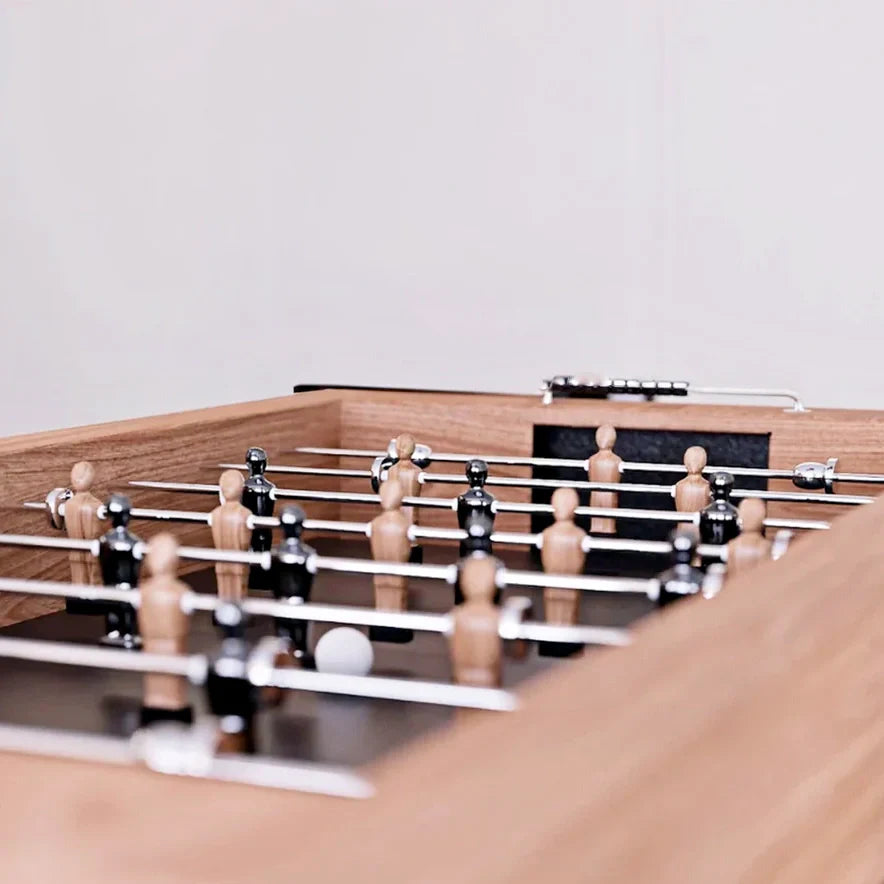
There is a point at which abundance stops feeling luxurious. A pool table, poker table, foosball table, arcade cabinet, shuffleboard table and golf simulator may all be desirable, but putting them within one visual field can make even a very expensive room look like an amenity center.
If the architecture allows it, separate activities. A card table can live in an alcove. A simulator can sit behind doors. A chess table can occupy a window bay. Even within one large room, changes in lighting, rugs or furniture arrangement can create distinct zones.
Luxury is often less about how much a room contains than how little of its effort is visible.
Let technology disappear
The same principle applies to screens, speakers and controls. A large television may be essential on game night, but it does not need to dominate the room every afternoon.
Flush-mounted speakers, concealed wiring, integrated controls and screens incorporated into millwork keep the room quiet when the technology is off. This is especially important in rooms that open directly onto the rest of the house.
The room should work on a night when nobody plays
This is the simplest test.
Imagine six people in the room and nobody touches a cue. Is there somewhere comfortable to sit? Is the lighting flattering? Can two people have a conversation without shouting? Does the room still feel complete?
If the answer is yes, the design is probably working.
The best luxury game rooms are not successful because they hide the fact that games are played there. They succeed because the games are only one layer of the room. The architecture, furniture, lighting and materials are strong enough to stand on their own.
That is what keeps the space from feeling like a themed room. It feels like part of the house first. The pool table just gives everyone a reason to stay a little longer.
0 comments